
Light, Balanced, or Strong: How to Choose Rewrite Depth for an AI Draft
Choose Light, Balanced, or Strong rewrite depth by looking at how much of your AI draft still works, what must stay unchanged, and how closely you need to compare the result.
In this article
A draft can have one awkward opening or a repetitive pattern running through every paragraph. Those are different editing jobs, so they should not start with the same rewrite depth.
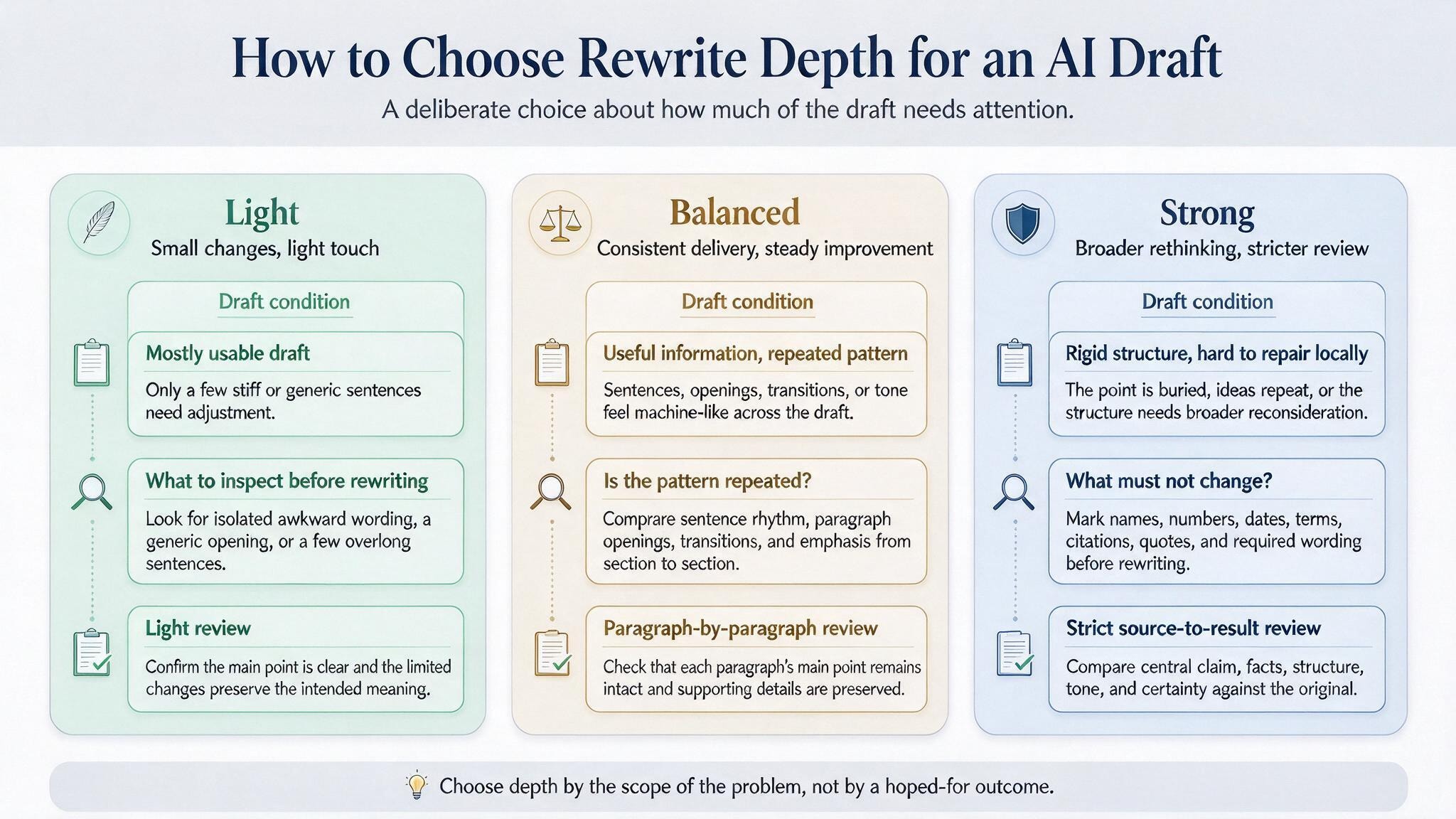
HideGPT offers Light, Balanced, and Strong rewrite-depth options. Treat them as deliberate choices about how much of the draft needs attention, not as a guarantee about the final result.
Start with three questions
Before choosing a depth, read the draft once without editing and ask:
- How much of the current wording still works? If most sentences are clear and only a few sound stiff or generic, the draft may need a lighter touch.
- Is the problem isolated or repeated? One formulaic introduction is different from the same sentence shape, transitions, and emphasis appearing throughout the text.
- What cannot change? Mark names, numbers, dates, technical terms, citations, quoted language, and required wording before you revise.
The third question matters at every depth. A broader rewrite can improve delivery, but it also gives you more to compare against the source.
Choose Light when the draft is mostly usable
Choose Light when the point, structure, and most of the phrasing already fit the task. This is a sensible starting point when you want to address a narrow issue, such as:
- a generic opening that says little
- a few overlong sentences
- repeated filler such as “it is important to note”
- a tone that feels slightly formal or distant
For example, a short product update may be accurate and well-organized but open with two abstract sentences before giving the actual news. That is a focused editing problem. Keep the useful structure in view and review whether the revised opening now reaches the point sooner.
Choose Balanced when the pattern appears across the draft
Choose Balanced when the draft has useful information but its delivery feels consistently machine-like. Look for signs such as repeated sentence length, similar paragraph openings, stacked general benefits, or transitions that could be moved between topics without changing much.
A common case is a three-paragraph article where every section follows the same pattern: a broad claim, a list of advantages, then a vague conclusion. The problem is not one word. It is the repeated rhythm and emphasis.
After a Balanced rewrite, compare the source and result paragraph by paragraph. Check that the main point of each paragraph still appears and that supporting details have not been softened, removed, or expanded.
Choose Strong when the draft needs broader reconsideration
Choose Strong when the wording and organization both feel too rigid to repair with a few local changes. For instance, the draft may bury its point under abstract setup, repeat the same idea in several forms, or use a predictable structure from beginning to end.
A stronger rewrite should also mean a stricter review. Do not assume that a larger change is automatically a better one. Compare the result against the source for:
- the central claim and its qualifications
- facts, names, dates, numbers, and technical terms
- citations and quoted wording
- paragraphs, lists, headings, and other required structure
- conclusions that may now sound broader or more certain than the source
If a sentence has become smoother but less precise, restore the precision. Clear writing is not an excuse to change what the draft actually says.
Preserve formatting when the structure does work
Formatting can carry meaning. A list may be a set of requirements, a sequence of steps, or a group of exceptions. Paragraph breaks may separate distinct ideas that readers need to scan quickly.
HideGPT can preserve formatting, including paragraphs and lists. Use that option when the draft's layout is part of its job, then verify that the result still makes the hierarchy clear.
Use one comparison routine after every rewrite
Whatever depth you choose, finish with the same short routine:
- Put the source and rewritten version next to each other.
- Verify facts, citations, names, numbers, and terms that must remain exact.
- Check that lists, paragraphs, and headings still serve their original purpose.
- Read the final version for tone and clarity.
- Approve only wording you are ready to publish.
HideGPT does not guarantee that text will pass every AI detector. Rewrite depth is an editing control, not a detector strategy. The useful question is whether the final wording communicates the original point clearly and accurately.
Final checklist
- I chose depth based on the scope of the problem, not on a hoped-for outcome.
- I marked details that must not change.
- I preserved formatting where it carries meaning.
- I compared the source and result closely enough for the selected depth.
- I reviewed facts, citations, and final wording before using the text.